The Latency Tax: Why Your Healthcare Facility is Losing 33 Hours a Month to "Paperwork Purgatory"
The Latency Tax: Why Your Healthcare Facility is Losing 33 Hours a Month to "Paperwork Purgatory"
Stop losing 33 hours monthly to "Paperwork Purgatory." Learn how intelligent data extraction unlocks "dark data" from faxes and notes, slashing administrative burnout and returning clinical focus to patient care.
In the modern clinical environment, data is the most abundant resource and, paradoxically, the most significant operational bottleneck. While a single patient generates over one million gigabytes of health-related data in their lifetime, the equivalent of 300 million books, roughly 80% of this intelligence is "dark". It is trapped in unstructured formats: handwritten physician notes, faxed referrals, image-based lab results, and physical ID cards.
For providers, this is the "Latency Tax." It is the invisible cost of a specialist waiting for a non-searchable PDF to be manually transcribed, or a billing department fixing a typo in a claim form. To reclaim clinical focus, organizations are moving beyond basic digitization toward intelligent data extraction software that bridges the gap between physical documentation and Electronic Health Records (EHR).
What is the primary bottleneck in healthcare data interoperability?
The primary bottleneck is the "80% Problem": the vast majority of patient data exists in unstructured formats like faxes and handwritten notes that cannot be parsed by standard EHR systems. This creates "Dark Data," which leads to clinical delays, administrative burnout, and revenue cycle leaks due to manual entry errors.
The operational cost of this Dark Data is quantifiable. Studies suggest that 20% of medical errors are linked to missing patient information, and nurses often spend nearly a quarter of their shifts on "clerical burden" rather than patient care. By implementing unstructured data extraction automated workflows, facilities can slash data processing time by as much as 80%, reclaiming approximately 33 hours of staff time every month.
How does intelligent data extraction software solve the "dark data" problem?
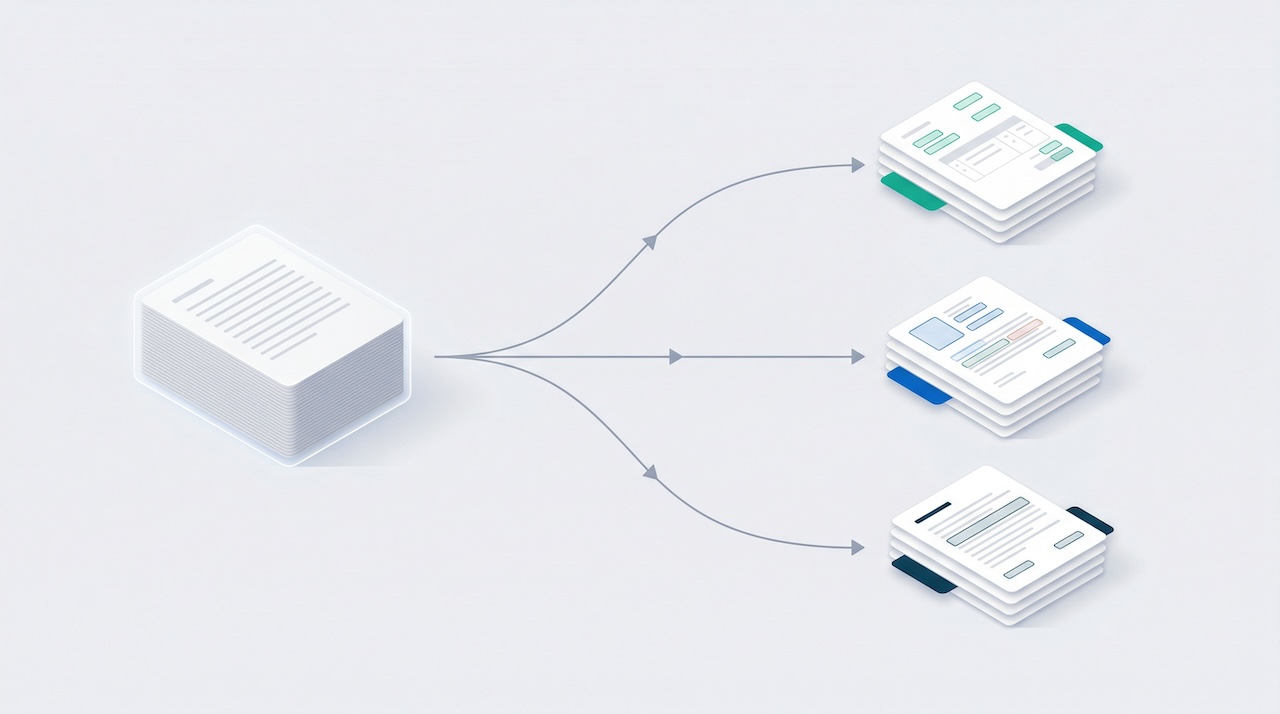
Intelligent data extraction software utilizes machine learning and Natural Language Processing (NLP) to "understand" document context rather than just "seeing" text. Unlike traditional OCR, it identifies specific entities, such as dosage instructions or ICD-10 codes, and converts them into structured JSON data that integrates directly with EHR and billing platforms.
This technology represents a shift from "Reading" to "Understanding." For instance, an automated data capture API can:
- Parse Handwriting: Accurately transcribe diverse physician notes that traditional rule-based systems fail to recognize.
- Auto-Categorize: Use a document splitter to separate incoming faxes into patient referrals, lab results, and insurance authorizations before extraction begins.
- Verify Accuracy: Cross-check extracted demographics against existing databases to flag discrepancies before they enter the clinical workflow.
Beyond the Clipboard: Three Use Cases for Clinical Automation
1. The 8-Day ROI of Patient Onboarding
Traditional intake involves manual photocopying and data entry, which is highly prone to typos. By utilizing automated data entry software, facilities can extract patient demographics and insurance details from ID cards in seconds. One analysis showed that this level of automation can pay for itself in as little as 8 business days.
2. High-Precision Referral Management
Referrals are often the messiest part of the data chain. Using NLP to read free-form doctor notes allows systems to automatically categorize the urgency and department for new patient referrals. This ensures that critical cases move to the top of the queue without an administrative staff member having to read every single page manually.
3. Medical Billing and "OCR Accounting Automated" Workflows
Revenue cycle management (RCM) is frequently crippled by manual errors in medical receipts and bills. Implementing an ocr accounting automated system allows for the rapid conversion of medical receipts into structured formats like Excel or CSV. This accelerates claim verification and streamlines fraud detection by comparing extracted data against policy terms in real-time.
Security-First Architecture: Protecting SPI in the API Age
In an industry governed by HIPAA and GDPR, the security of an automated data capture API is non-negotiable. Modern solutions emphasize a "Zero-Click" workflow where patient data moves from a scanner to the EHR via secure, encrypted RESTful APIs without a human ever touching a keyboard.
Furthermore, the barrier to entry has vanished. Instead of needing months of training on massive datasets, healthcare admins can now train a new "extractor" for a specific form using a single sample image in minutes. This agility allows facilities to scale their operations without a proportional increase in administrative headcount.
Conclusion: Returning Care to the Clinician
The adoption of intelligent data extraction software is not merely a technical upgrade; it is a human-centric necessity. When we solve the 80% crisis, we move away from a world where doctors are forced to act as data-entry clerks and back to a world where they are healers. By unlocking unstructured data today, healthcare organizations are building the foundation for the AI-assisted diagnostics and high-velocity care of tomorrow.